
Andromeda's KDS replaces paper tickets with smart screens that route orders by station, time every step, and coordinate courier hand-off — so food leaves hot and ratings climb.
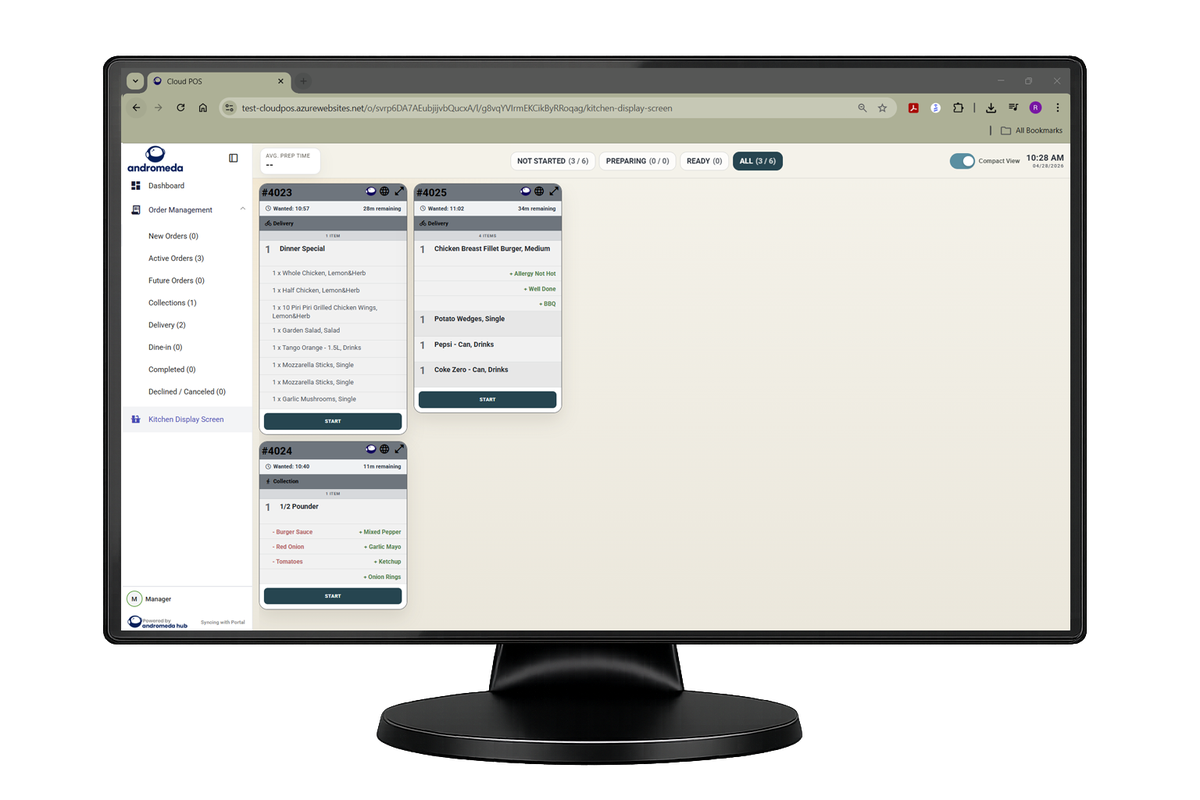
Paper tickets get lost, smudged and missed. A KDS puts every order in front of the right chef, at the right moment, with a timer that keeps the line honest. In a Friday-night kitchen that difference is measured in minutes per order — and in rider reviews, repeat customers and revenue.
One station, two live orders, timers on the right — green for on-pace, amber when it's time to move.
Every order appears on the screens it needs to — grill, fryer, cold bench, drinks, expedite — the moment it's accepted. No walking tickets across the kitchen. No "did we start that one?". The elapsed-time counter keeps the line disciplined: green while you're on target, amber when the order is about to slip, red if it has.
Modifier notes stand out. "No pickle" isn't going to get missed in pen scrawl — it's on-screen, in the right colour, where the chef is already looking.

Tickets arrive instantly, route to the right station and never go missing. Kitchens typically shave one to three minutes off an average order once paper is retired.
Modifiers, substitutions and allergen flags are displayed clearly on the screen, in colour, right where the chef is working. Nothing gets scribbled, folded or dropped behind the pass.
Accepted, started, bumped, packed, out-the-door — every stage is stamped automatically. Make time, rack time, OTD and TTD feed straight into reporting so you can spot the bottleneck.
Put one screen at the grill, one on the prep bench, one at the pass. Or split by cuisine — tandoor, curry pans and starters on separate screens. Each only shows the items it needs to cook.
The KDS coordinates with dispatch so your drivers, Uber Direct or Stuart are scheduled for the moment the bag closes — not fifteen minutes early (cold food waits) or ten minutes late (riders wait and food cools).
Accurate orders, hot food and on-time hand-off are the three biggest drivers of Uber Eats, Deliveroo and Just Eat ratings. The KDS hits all three — and better ratings mean more visibility and more orders.
Meals that arrive hot and correct are the foundation of repeat business. Andromeda sites moving from paper to KDS consistently see higher repeat-order rates — which shows up directly in revenue per site.
Till, web, app, kiosk and aggregator orders land on the same screen — in the same queue. The kitchen doesn't care where the order came from; it just cooks the next one in line.
| Capability | Paper tickets | Generic third-party KDS | Andromeda KDS |
|---|---|---|---|
| Orders arrive instantly at the right station | ✗ Printer queue delay | Usually | ✓ By product, per screen |
| Elapsed timer per order | ✗ | Basic | ✓ Colour-coded, per-station targets |
| Modifier & allergen highlighting | Hand-written | Plain text | ✓ Colour-coded and unmissable |
| Timestamps feed reporting | ✗ | Separate database | ✓ Straight into make / OTD / TTD |
| Courier hand-off timing | Manual guess | Not integrated | ✓ Dispatch scheduled to ready-time |
| Works for every channel together | Separate printers | Often POS-only | ✓ Till, web, app, kiosk, aggregator |
| Multiple screens per kitchen | Multiple printers | Licensed per screen | ✓ As many as you need |
"Before the KDS, Friday night was chaos — tickets on the counter, chef shouting over the fryer, wrong orders out the door. Now every station has its own screen, the timer keeps us on pace, and our Uber Eats rating climbed half a star in six weeks. That's real orders, real money."
A Kitchen Display System (KDS) replaces paper kitchen tickets with screens. Orders appear in front of the chef as they arrive, route to the right station automatically, and timers keep the line on-pace. You get faster production, fewer lost tickets and a full timestamp trail for every order.
Yes. Stations are assigned by product — a pizzeria might have one screen at the oven and another at the make line; an Indian restaurant might split tandoor, curry pans and starters; a burger kitchen might separate grill and fryer. Every screen only shows the items it needs to cook.
Every order is stamped at accept, prep-start, bumped-from-station, packed and out-the-door. Those numbers feed Andromeda's reporting — make time, rack time, OTD and TTD — so you can see exactly where the minutes are going and who is running hot or slow.
The KDS knows when food is ready. For delivery orders it coordinates with dispatch so couriers — your own drivers, Uber Direct or Stuart — are scheduled to arrive as food is being packed, not fifteen minutes before or ten minutes after. Fewer cold meals, fewer frustrated riders, better aggregator ratings.
Aggregator ratings are heavily influenced by order accuracy and hand-off timing. A KDS removes dropped and smudged paper tickets, makes modifier changes impossible to miss, and gets couriers to the counter at the right moment. Sites moving from paper tickets to Andromeda KDS typically see rating and repeat-rate uplift within a few weeks.
No. The KDS runs on standard commercial touch-screens — the same screens many kitchens already have. We can advise on kitchen-safe hardware (IP-rated, heat-tolerant, wipe-clean bezels) as part of implementation, but we don't lock you into proprietary devices.
One queue for till, web, app, kiosk and aggregator orders — feeding the same KDS screens automatically.
See order management →Dispatch your own drivers or fall back to Uber Direct and Stuart — timed to KDS ready-at, not guessed.
See delivery →The till, menu and reporting that sit behind the kitchen screens. One platform, one source of truth.
See the EPOS →Book a 30-minute demo and we'll walk you through the KDS on a kitchen layout like yours — grill, prep, pass — with live timers, courier hand-off and aggregator orders landing in real time.
Book a demo